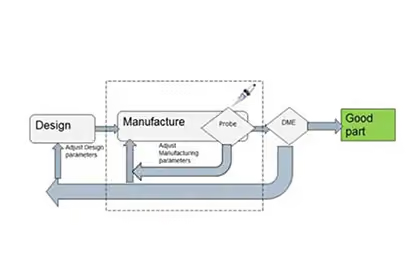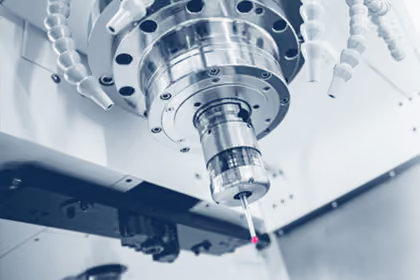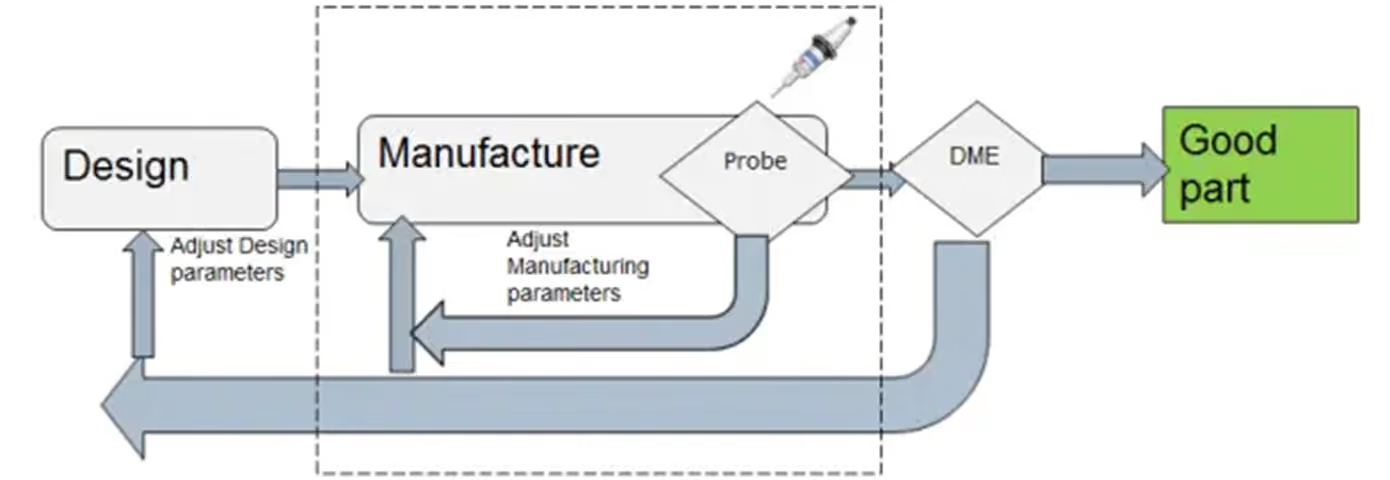
Modern manufacturing demands high precision and cost efficiency, especially for complex parts. This paper explores how integrating CAD-based metrology software directly with machine tool controllers enables CMM-style measurement during machining. This innovation forms a closed-loop feedback system, improving quality and reducing costs.
As parts become more geometrically complex, measuring them directly on the machine tool—rather than externally—is increasingly essential. This approach:

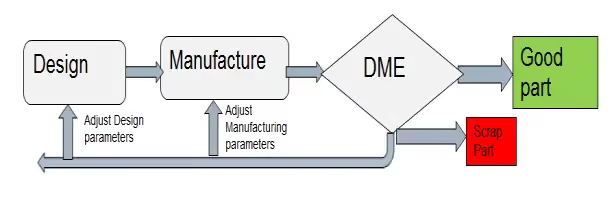

Total error in measurement is the sum of:
To isolate Em, Es must be minimized. This involves:
Machine tool probes must be calibrated for:
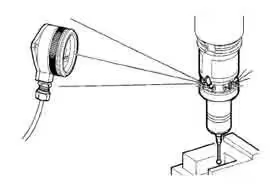
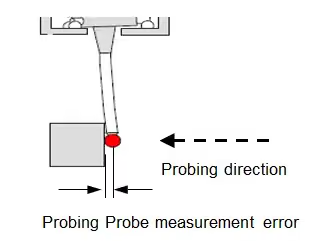
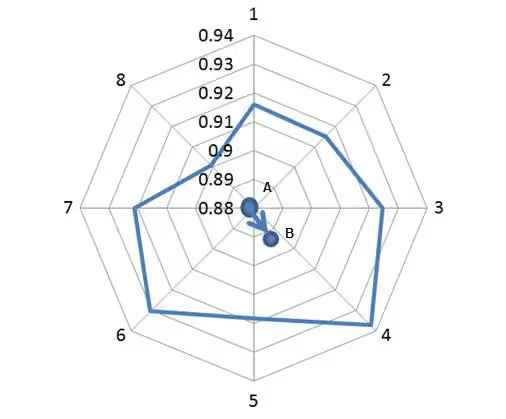
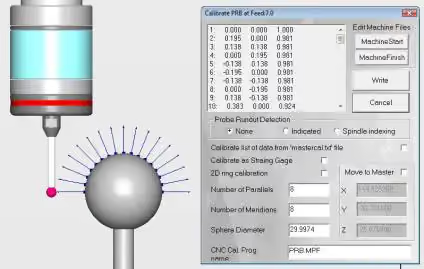

Advanced calibration routines use ring gauges, calibration balls, and multi-axis compensation to ensure accuracy.
A 3-axis machine has 21 potential error sources; 5-axis machines have even more. These include:
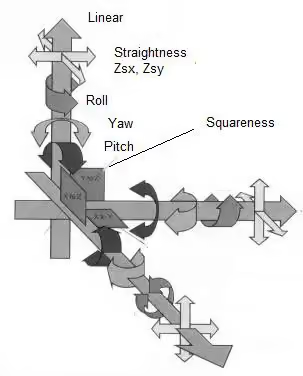

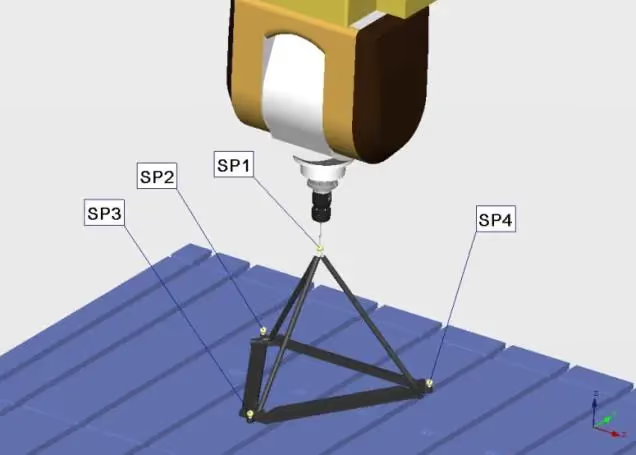

Incorrect part positioning leads to machining errors. In-process measurement solves this by:
Integrating metrology into the machining process transforms traditional manufacturing into a smart, adaptive system. By embedding measurement and feedback directly into the machine tool, manufacturers can achieve:
ERRORS DUE TO WORKPIECE HOLDING
Machine tool cutting programs are generated at an assumed location where the part would be held. These are usually stored as a translation value under the work offset parameter of the machine tool controller. Some controllers also have options to apply the parts orientation in terms of its rotation from the intended axes.
Any errors in holding the part precisely from the intended location would cause the machine to cut at a wrong location. If a hole is to be drilled at a location, it would be drilled at a slightly different location because the part is not exactly where it should be even though the machine was at the correct coordinates.
Extracting part from a block
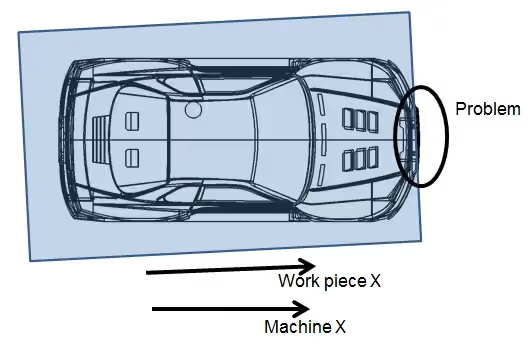
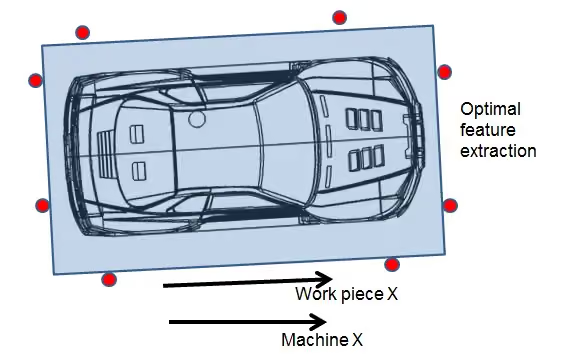
Cutting out a part from a square block is a simple example of how in-correct piece holding can affect the result. The initial shape could be a block as it is the case in a lot of molding applications, or it could be a pre-cast or wrought material with a non-uniform starting shape needing to be finished. In order to make sure that this operation is performed with a good part extraction, without in process measurement the following must be considered.
Figure 13 shows the problem that could be caused by a mis-aligned work piece. As the work piece is located with a slight rotation, and especially with a little offset, it is possible that part of the cutting could be at the edge or out of the volume of the work piece.
By using in process measurement, a precise alignment of the part can be created. A program that could measure points around the block calculates the actual orientation and the center of the block. Figure 14 shows the screen where these points are used to create a work offset G56 for the alignment. During the execution of the program generated, this work offset is updated to the controller automatically.
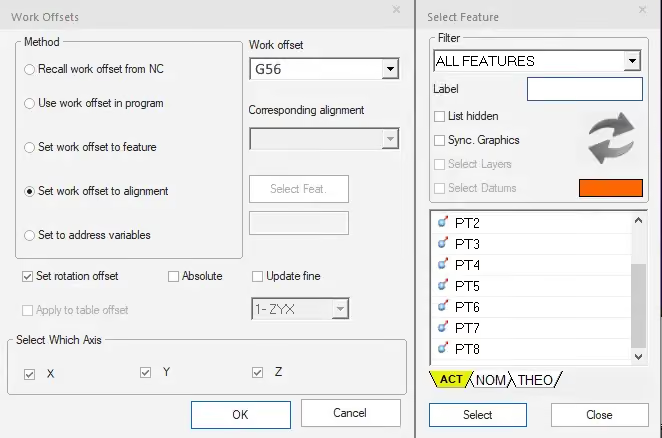
Once the controller is updated with this new alignment, cutting program adapts the machine motion to carve out material at the actual location. This allows a much smaller starting work piece size, and very small setup time which is performed automatically by the system without the need for an operator. Figure 15 shows the measurement points and finished product.
Advanced alignment methods
For parts with complex shapes such as non-prismatic features, the part alignment could be even more difficult without innovations in machine tool in-process measurement. Manufacturing impellers by surface finishing from a cast work piece is a good example of this.
Figure 16 shows one of these parts to be processed on a 5-axis table machine.
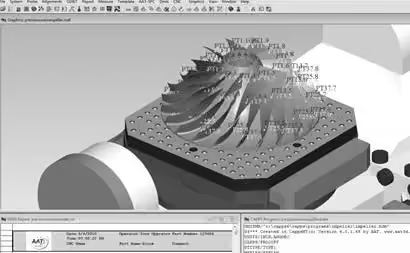
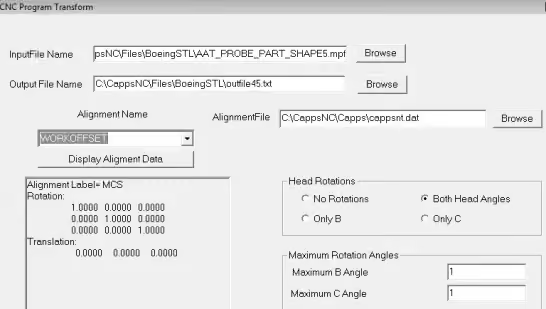
By using the CappsNC in process measurement software, a set of measurement points are created, and a measurement program is generated. The results of this measurement data is used to compare with the original CAD model of the part calculating profile errors. A 3D best-fit function is also introduced into the measurement program by using best-fit settings shown in Figure 17. As a result, a part coordinate system which allows the machine to process this part at the shortest time without any risk of undercutting is calculated and updated as a set of correction parameters to the machine tools controller.

The correction parameters for this kind of application are written either as an extended 6 degree of freedom work offset with part location and orientation or it could be applied as an offset to the A and C rotations of the table by bringing the part to the optimal position for the cutting process.
Manufacturing airfoils and blades
In some cases, the special shape of the part such as the airfoil of a jet engine, or a gear profile would require special mathematics and methods to manufacture this component or to repair it. In addition to calculating precise part location to help manufacturing, a special algorithm that calculates specific parameters or simulating a gaging method normally applied external to manufacturing is necessary. Innovations in machine tool in-process measurement make this possible by integrating special measurement functions and using a high-level metrology programming language DMIS.
By automatically calculating points at cross sections of the blade, the centroid, leading and trailing angles and radius, and locations of special gaging points are calculated by the measuring software. Having these parameters automatically updated in the controller allows the cutting program to adapt to the actual condition of the part.
When repairing a blade or gear, the reverse engineering method is applied. A probing program that can adaptively digitize a shape or a curve measuring program is executed creating a CAD entity representing the actual profile. This profile is then exported into a CAD file in Iges or Step formats automatically from which a CAM program creates a new cutting path that repairs the part without damaging it.
Manufacturing of large parts
Manufacturing large parts such as an automotive die requires special in process methods. To have these kinds of parts measured on an external measuring device would be very expensive and sometimes not practical at all. Parts may have to be moved back and forth multiple times to measure and apply corrections based on these measurements. Figure 18 shows an example of such repair process.

The unique measurement method this process requires is the ability to manually move the machine to locations where the desired features will be measured. For example, the four-hole locations are initially not at a known location to be able to run an automatic probing program. However, using CappsNC software, a specialized macro is quickly generated to allow the user to bring the machine above each hole and start an automatic measuring cycle. The calculated images of these features are automatically displayed on the software screen and by using them an exact alignment is calculated. This alignment is later uploaded to the controller to allow the machine to perform the cutting process correctly.
Similarly, curve profiles or surface measurement macros can also be generated and executed at the desired locations. The collected measurements in this case are immediately compared to the CAD solid model and a measurement report is generated.
6.5 Large non-rigid part manufacturing
When manufacturing very large parts such as composite structures or a wing of an aircraft, it could be very difficult to hold the part within the intended location. Furthermore, because of the size of the part, just with its own weight or with clamping, it could take a slightly different shape.
Figure 19 shows an example of wing trim and drill operation.
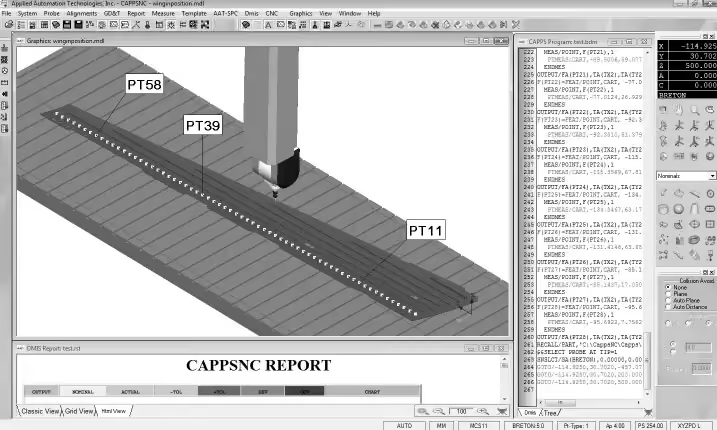
The goal is to adapt the cutting or drilling program to precisely follow the shape which the part takes. Since this shape will be different for each part, a probing program is generated from the CappsNC software to measure its profiles. Any numbers of coordinate systems along the length of the part or sections in consideration are generated. This data is then used by a special program called, AAT-NCFIT to adapt the cutting program to follow the exact shape.
A screen of the NCFIT is seen in Figure 20.
Several in process measuring programs can be developed and stored in the machine tool controller for optimizing tool compensation. These programs at the different phases of the cutting process are started automatically and corrections are uploaded to the controller in real time for the next cutting operation to adapt to the changes of the tool shape. This in process method is especially used in large volume mold manufacturing such as cell phone mold manufacturing.
7.2 Deflection of part under cutting forces
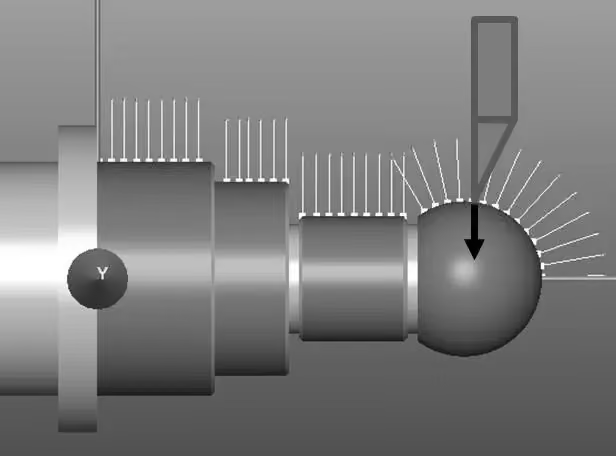
In some applications, part itself can change its shape under forces applied during the cutting process. This could be the case when manufacturing parts with thin walls such as airfoils. One important application where in process measurement helped with CappsNC software is manufacturing high precision parts on a turning application. In this case an automatic measurement program is used to measure the profile errors of the part just before final finishing cut. These errors are used to automatically update the
machine’s pitch correction table and part is cut again with these new corrections active. This way, the part errors measured by the in-process system are used as a direct feedback to the machining process correcting the effects of the forces on the part.
Figure 23 shows an example of this process.
Thermal compensation
Another important cause of manufacturing error is the thermal expansion of both the part and the machine. The changes in the temperature could be very unpredictable and the effects on the system are non-linear. One method of correction for the thermal expansion is by applying a compensation method directly into the in process measuring software. Figure 24 shows the configuration screen for in process thermal compensation for both the part and machine.

Although this method of compensation for the thermal expansion is quite effective for the measurement results, this by itself does not really help the manufacturing process as the correction is applied only on the measurement software. For this reason, an in-process method is adapted to directly measure the effects of the thermal expansion and correct it for the manufacturing process itself. This method is especially helpful when the effects of thermal expansion is nonlinear, i.e., for a turning application, most of the expansion is on the location of the turning table and not the machine actual axis itself. By measuring this shift with the aid of a simple gage, the active work offset is calculated and corrected hence allowing the machining program to adapt to this thermal change.
SPECIAL APPLICATIONS
In process measurement is applied in many special applications to both help with manufacturing process and to generate measurement and metrology reports without taking the part off from the machine tool. Two of these applications are mentioned below.
Measurement of aerospace part on an 8-axis robot
Aircraft structures are manufactured by a supplier of Boeing using an 8 axes machine with a robot. There are many hole locations at different orientations being drilled. Incorrect positioning of these features causes a lengthy approval process to repair and is very expensive even if they could be saved from scrap. By using an in-process measurement strategy, both part locations are calculated and hole locations before and after drilling are measured. CappsNC software has a virtual machine modeling (VMM) feature where a true simulation of the complete machine is possible. Geometric measurement paths are created automatically with optimum tool orientation to align the probe with the hole axis. Automatic collision avoidance also allows a very fast and safe program generation. Figure 25 shows the CappsNC screen for this application.

Manufacturing high precision cutting tools
A manufacturer of high precision cutting tools is interested in using in process measurement to assure that the end-product achieves the intended cutting envelope. The actual frame of the cutting tool and the pockets where the actual cutting bits would be planted are manufactured by using 5 axis machine tools. By using the CapsNC software, an in-process measurement strategy is developed to measure the cutting tool pockets. From these measurements and by using the nominal dimensions of the cutting bits, the actual cutting envelope is calculated and compared to the desired envelope. The deviations are reported as a measurement report and applied to the cutting process as correction.

9. IN PROCESS METROLOGY
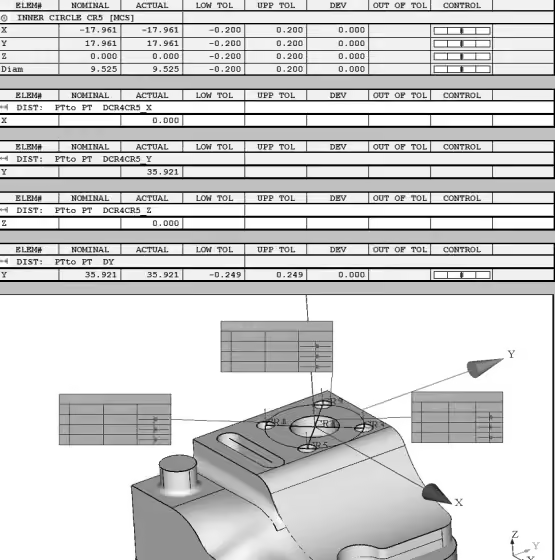
In addition to using in process measurement for the purpose of helping the manufacturing system, it could also be used as a metrology device allowing to use the machine tool very similar to a coordinate measuring machine (CMM). It has been shown up to now that by applying the algorithms and methods developed within the CappsNC software, the measurements collected on the machine tool can be trusted. By programming the machine from a CAD model, any type of features can be measured with any number of points. For example, a cone with multiple points can be measured and both its form and angle can be reported. A surface profile can be measured by quickly developing a program that measures many points at different vectors. Through innovations in machine tool in-process measurement, measured features can be referred to create true position call outs at different settings.
CONCLUSIONS
Throughout this paper, we showed that in-process measurement is a very important part of sustainable manufacturing strategy. By using a measuring probe and metrology software with the ability to directly connect and interface with the manufacturing system, it is possible to make complex measurements on any type of part and machine tool.
The most important benefit of in process metrology is enhancing the manufacturing process in a number of ways by reducing the effects of various errors on the manufacturing quality. Advanced measurement analysis reports are used as a correction hence achieving ‘closed loop metrology feedback’ within the manufacturing cycle. It has been demonstrated that this method can be applied on very complex parts manufactured on multi axis machine tools and robots.
The benefits of innovations in machine tool in-process measurement is seen not only on large parts where it is a must to use as moving the part to a CMM would be very expensive or just impossible but also on small parts high volume manufacturing by automating the measurement process within the manufacturing cycle.
Complete measurement reports with metrological analysis can also be generated without additional effort making the in-process measurement a very powerful tool for sustainable manufacturing. New innovations in machine tool in-process measurements are now being applied by many leading manufacturing companies from aerospace and automotive applications to cell phone mold applications.
Ray Karadayi
Applied Automation Technologies, Inc.
1688 Star Batt, Rochester Hills, MI, 48309 USA
Phone: 248-340-6934
ray.k@aat3d.com